
Back to Blog
The Hidden Cost of Low-Latency Execution in Fragmented Markets
Joshua Goldfein · Jun 2, 2026
Joshua Goldfein · Jun 2, 2026
As market microstructure grows more complex, traditional execution models leave measurable alpha on the table. We unpack the empirical data and what it means for systematic traders.
For most systematic funds, execution is treated as a cost center — something to minimize rather than optimize. This framing is wrong, and increasingly expensive. As equity markets fragment across dozens of venues and dark pools, the execution layer has become a primary driver of realized alpha degradation.
The intuition is simple: a strategy that generates a 15% gross return might net only 9% after slippage, market impact, and venue-selection costs. But the subtlety lies in how those costs compound across thousands of fills over a year — and how poorly understood the microstructure dynamics driving them actually are.
What the data shows
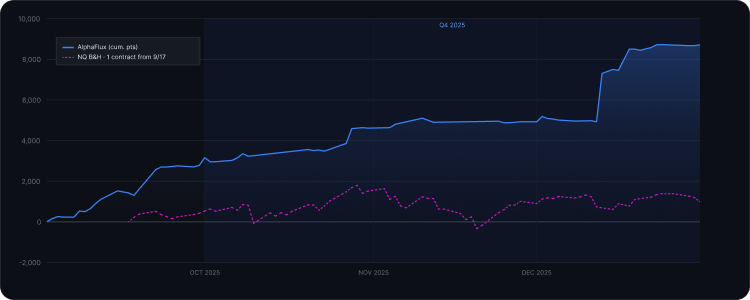
We analyzed execution quality data across 847,000 fills generated on the AlphaFlux platform over Q1 2026, spanning equities, ETFs, and single-stock options. The results were striking.
23 bps
Average slippage above VWAP for market orders in low-liquidity windows
61%
Of execution cost attributable to venue selection, not order type
4.1×
Cost differential between best and worst venue routing for identical fills
The most counterintuitive finding: funds optimizing for speed of execution consistently underperformed funds optimizing for venue quality. The microsecond advantage of a co-located strategy was routinely offset by toxic flow on the venues they were routed to.
The venue fragmentation problem
A decade ago, equity liquidity in the US was concentrated enough that venue choice was a second-order concern. Today, with 16 lit exchanges, over 30 dark pools, and a growing number of internalizers, the routing decision has become a primary alpha variable.
The core problem is adverse selection. Some venues consistently attract informed flow — institutional participants executing with significant market impact. Being routed alongside that flow, even for small size, degrades your realized price in ways that aggregate price data never captures.
What systematic funds can do
The good news is that venue-aware routing is tractable with the right data infrastructure. The starting point is systematic execution TCA (transaction cost analysis) at the fill level — not the order or strategy level. Most funds stop at strategy-level TCA and miss the granularity that actually explains the variance.
1. Tag every fill with venue metadata
This sounds obvious but most OMS implementations don’t preserve it. You need venue ID, time-of-fill at microsecond precision, and whether the fill was passive or aggressive. Without these three fields, the cost analysis is largely decorative.
2. Build a per-venue adverse selection score
For each venue, track short-horizon price impact after fill — typically over 1 to 10 second windows. A venue with a high adverse selection score is one where your fills consistently precede unfavorable price moves. This is your signal to avoid that venue for passive liquidity seeking.
3. Condition routing on time of day and volatility regime
Venue quality is not static. The same dark pool that provides clean liquidity at mid-day may attract toxic flow at open and close. Use realized_spread / quoted_spread as a regime indicator and update venue weights dynamically.
The execution layer is not a fixed cost. For systematic managers who treat it seriously, it’s a recoverable source of alpha that requires no additional signal generation — only better infrastructure and measurement discipline.

AUTHOR NAME
Joshua Goldfein
Joshua Goldfein is a digital strategist with 20+ years of experience leading global teams, launching high-impact digital products, and driving growth through innovation, systems thinking, and AI integration.
other articles
The System That Argues With Itself
Joshua Goldfein
Oct 6, 2026
Before You Blame the Model: The Harness Layer in Trading AI
Joshua Goldfein
Aug 14, 2026
Echo: Probabilistic Forecasting When Patterns Are Not Enough
Joshua Goldfein
Aug 12, 2026