
One tick in.
Seven layers deep.
One order out
AlphaFlux is an applied AI system that happens to trade futures. The trading thesis is orderflow. The engineering thesis is layering: isolate learned components to the layers where judgment is genuinely the problem, and make everything else deterministic, bounded, and replayable.
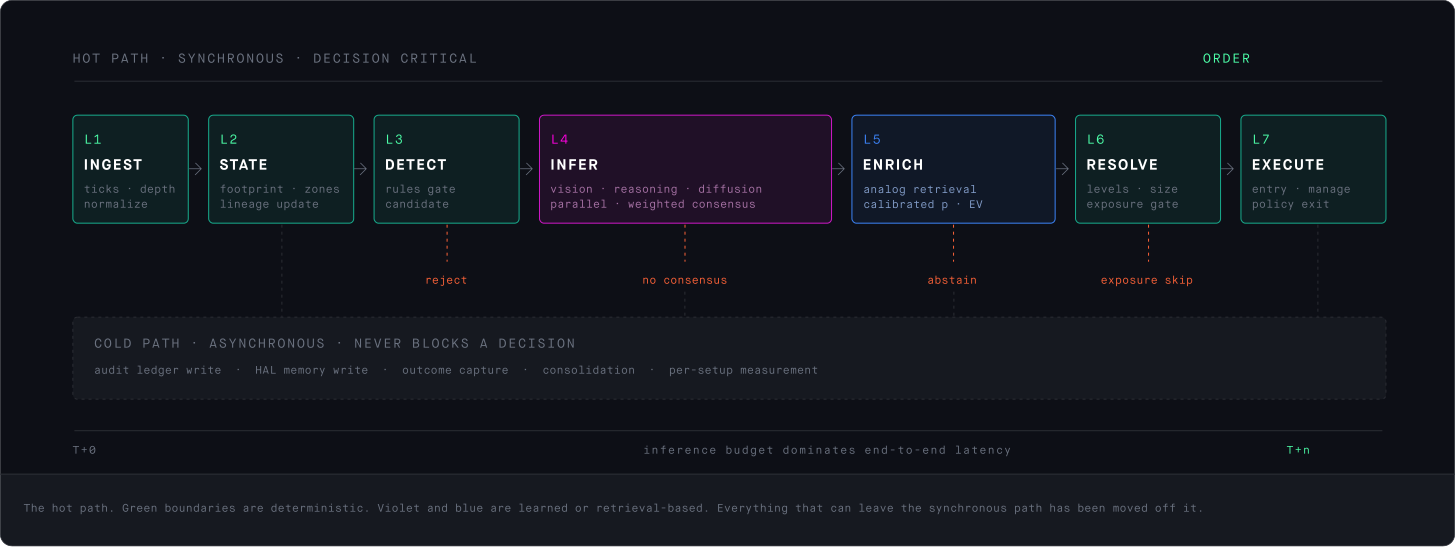
What follows is the decision path itself, followed end to end. Each layer has one job, one failure mode, and one contract with the layer above it.
Layering is the strategy
The hard problem in applied AI is not capability. It is containment: knowing which parts of a system are permitted to be probabilistic, and keeping the rest of it boring enough to reason about.
AlphaFlux draws that line explicitly. Two layers infer. Five compute. A learned component that misbehaves degrades a decision, but it cannot corrupt state, and it cannot originate a number that reaches an order. That containment is what makes the probabilistic parts safe to use aggressively.
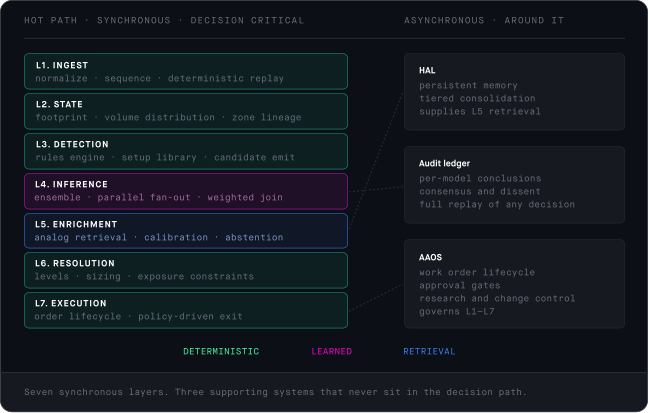
Three supporting systems sit deliberately outside the decision path. None of them can delay it.
Market state is a maintained object, not a query
Ticks and depth updates are normalized, sequenced, and folded into a continuously maintained representation: footprint, volume distribution, and zones. Nothing downstream reconstructs state on demand. It reads what L2 already holds.
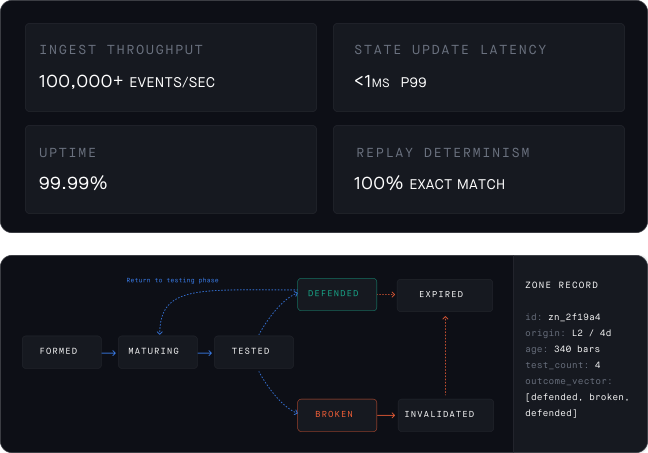
Determinism is the requirement that makes everything above it possible. The same input stream produces the same state on every replay, which is what lets a live decision and a historical decision be compared on equal terms. A validation regime built on non-deterministic state reconstruction measures the reconstruction, not the system.
Zones are the unit of structural context the rest of the stack consumes. A zone is not a price level. It is an object with a lifecycle that knows when it formed, how often it has been tested, and how it resolved each time.
Cheap filters run before expensive ones
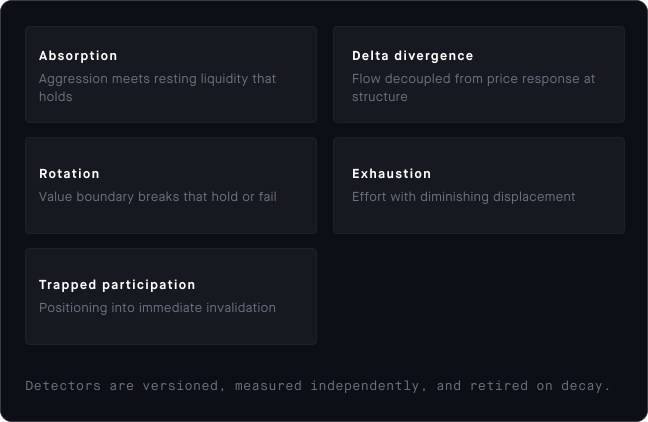
A rules engine evaluates encoded structural preconditions and emits candidates. This is an economics decision as much as a correctness one: inference is the most expensive thing in the stack, and nothing should reach it that has not already earned the compute.
Detectors fire on microstructural conditions at specific locations in structure. Location carries as much information as pattern, which is why L3 depends on L2 rather than running against raw data.
Fan out to specialists. Join on weighted consensus
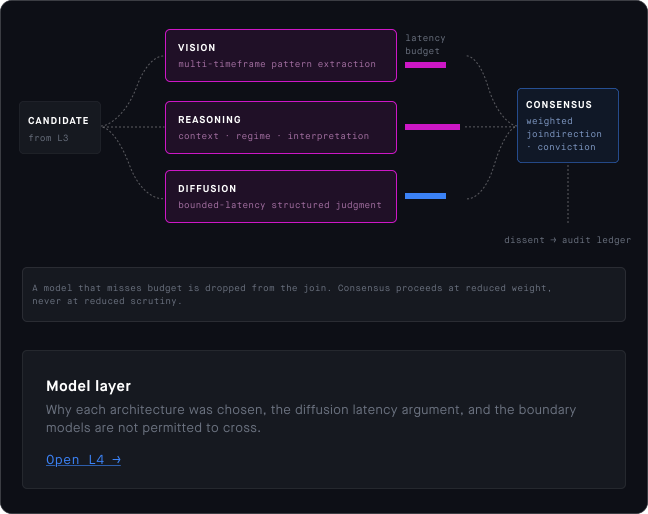
Reading two-dimensional market state, synthesizing context, and returning structured judgment inside a bounded window are three different problems with three different latency profiles. Routing all of them through one general-purpose model means accepting the worst tradeoff of each.
Three architectures evaluate the candidate concurrently. Outputs combine under weights that shift with volatility and confidence, and disagreement is retained rather than averaged away. A split ensemble is information about the state, not noise to be smoothed.
Conviction is not evidence
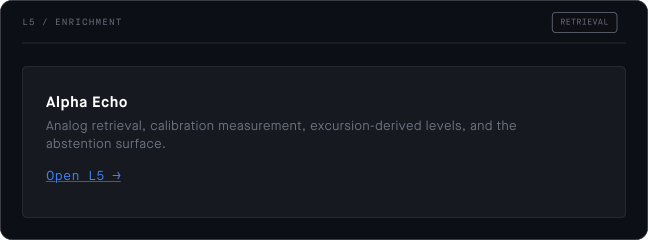
The ensemble produces a view. L5 tests it against the record. Alpha Echo retrieves prior states that resembled this one and reports what followed them: a calibrated probability, an expected value, and levels derived from how far price actually ran in each direction.
This is the layer that makes the rest of the ensemble safe to trust. A confident model and a correct model are different things, and the only way to tell them apart is to check the claim against outcomes, continuously, and track the gap.
When the retrieved evidence is too thin or too contradictory to support an estimate, Alpha Echo returns nothing. Abstention is a first-class output, not an error path.
Learn more about our Enrichment Layer >
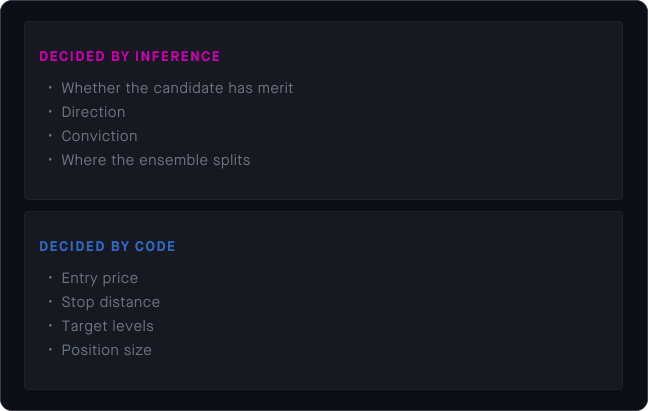
Judgment upstream.
Arithmetic here
No number that reaches an order originates in a model. Language models are strong at pattern and weak at precision, and the architecture is built around that rather than in spite of it.
The separation is also what makes a decision reviewable. Reasoning quality and execution correctness are recorded independently and can be wrong independently.
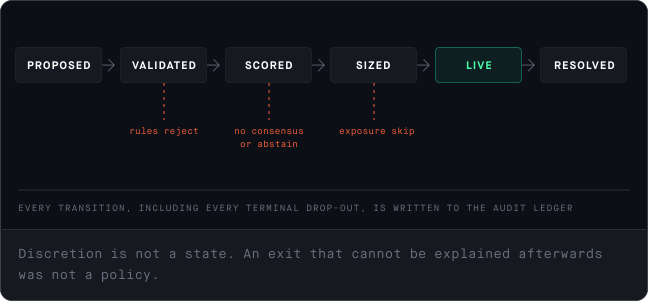
A candidate is a state machine
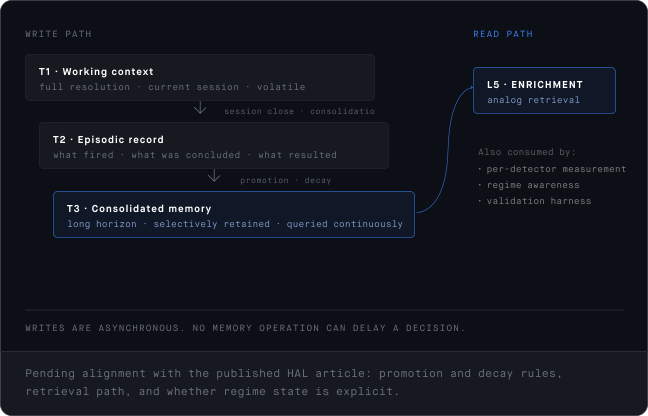
The system that trades is the system that remembers
Most automated systems are stateless between sessions. They wake with no recollection of the conditions they traded through yesterday, the regime they adapted to last month, or which of their own conclusions turned out to be correct.
HAL holds that state and consolidates it in tiers. Retention is selective rather than chronological: what survives, survives because it carries information. The consolidated record is what L5 retrieves against, what per-detector measurement runs on, and what the validation harness tests new logic against.
All of it is written asynchronously. Memory makes the next decision better. It never makes this one slower.
Failure design
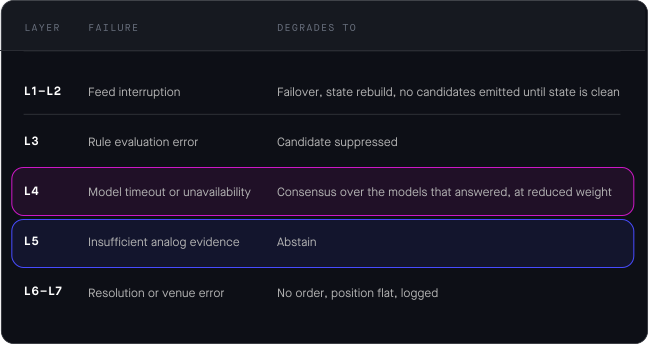
Every layer degrades to a safe state
Distributed systems fail partially, and an inference layer fails in ways a database does not: it can be slow, unavailable, or confidently wrong. The design assumption is that each of those will happen.
A layer that cannot answer within budget does not stall the path. It falls back, and every fallback is more conservative than the layer it replaces. The terminal state of a cascading failure is no position.
HOW THIS WAS BUILT
The build is governed the same way the trades are
AlphaFlux is developed and researched under AAOS, an agent orchestration and operating system. Every action a specification with acceptance criteria, an explicit lifecycle, and human approval gates at the points where judgment is required.
Research runs through the same protocol. A hypothesis about market behaviour is specified, tested, and recorded with the rigor of a code change, which means the research record is as reconstructable as the trade record. Both the system and the process that produced it can be replayed.
Systems of this kind fail more often from undisciplined process than from bad ideas.
AAOS Agentic Governance System is built by Mercury Digital and used across client engagements as well as internal research.